Al-arbaʿīn · the fortieth day
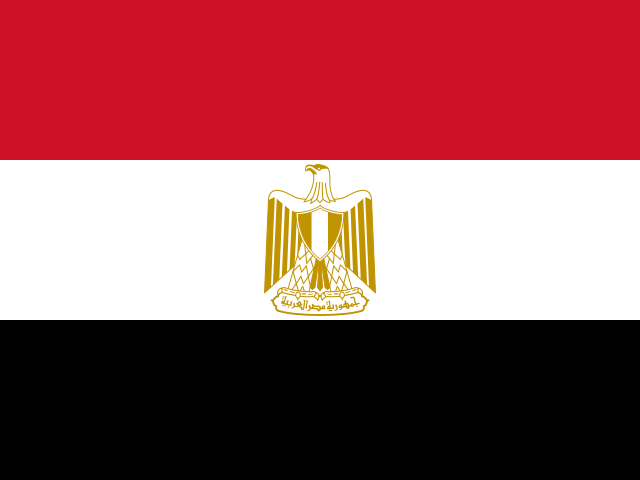
Egypt marks the fortieth day after a death with a major gathering of condolence and remembrance: Qur’anic recitation or memorial mass, visits to the grave, and the end of the first mourning: a custom with pharaonic echoes.
Does your family know it this way?
The names it answers to
- Al-arbaʿīnArabic (Masri) · "the forty"
What happens
- 1
The first mourning
From the funeral, the family receives condolences (ʿazāʾ); women of the house are accompanied through the early weeks.
- 2
The fortieth-day gathering
Family and community reconvene: recitation or church memorial, grave visitation, and shared food.
- 3
The easing
After the fortieth, heavy mourning eases; remembrance continues at anniversaries.
WHY
Forty days echoes the old Nile arithmetic of the soul’s preparation (the span of ancient embalming): Egypt has counted this interval for its dead across faiths and millennia.
A fixed reunion forty days on catches the mourners at the moment the world stops calling, and calls on them again.
WHYs are plural by design: your family may hold another. Dispute or add below; disagreement is recorded, never erased.
Who practices it



Provenance
- generated: 2026-07-04
- source: Model-knowledge aggregation pass (2026-07-04); unverified, awaiting community affirmation.
This entry is a hypothesis awaiting its people. If your family does it differently, that difference is exactly what we want recorded.
Nearby in the library
Sunan jariri · the Hausa naming day
On the seventh day the Hausa family gathers after dawn prayers; a ram is slaughtered, the child’s head may be shaved, and the malam whispers the name with the call to prayer in the child’s ear.
Hausa · Fulani · Muslim communities of Africa



Ngente · the Wolof naming day
The Senegalese eighth-day celebration: the child is named in the morning rite, and the afternoon becomes a grand social feast where the griot proclaims the name and lineage.
Wolof · Muslim communities of Africa

Sebou · the Egyptian seventh-day welcome
Egypt’s seventh-day celebration, older than Islam and Christianity in the Nile valley: the baby is carried in procession with candles, sieved and gently instructed, amid song and noise to make the child brave.
Egyptians · Coptic Orthodox Christians · Muslim communities of Africa